

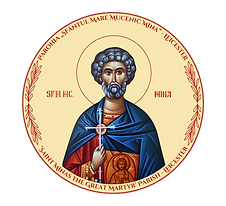
SAINT MINAS THE GREAT
MARTYR
THE TROPAR OF THE SAINT
Your martyr, O Lord, Mina, in his asceticism, received from You, our God, the crown of incorruption, for having Your power, he defeated his tormentors, and crushed the powerless audacity of demons. Through his prayers, save our souls, O Christ our God.
(November 11)

Saint Minas the Great is one of the most beloved saints of the Orthodox Church, known as a swift helper of those who are wronged, of those who suffer loss, and of those in distress. He was of Egyptian origin and lived in the third century, during the reign of the pagan emperors Diocletian and Maximian, a time when Christians were harshly persecuted for their faith in Christ.
Youth and Military Life
Saint Minas was raised in the Christian faith and, upon reaching young adulthood, enlisted in the Roman army, serving as a soldier under the authority of the tribune Firmilian in the city of Cotuan (Cotyaeum) in Phrygia, Asia Minor.
At that time, the emperors issued decrees throughout all the provinces that every citizen of the empire was to worship the pagan gods, and those who refused were to be put to death. Persecution spread everywhere, and many churches were destroyed.
Witnessing all this, the Blessed Minas could no longer endure the injustice and lawlessness of those who worshipped lifeless idols. Unwilling to be a participant in paganism, he abandoned his military rank and withdrew into the mountains, choosing the ascetic life.
There, the Saint devoted himself to prayer, fasting, and contemplation, serving God unceasingly and purifying his soul from every passion. He ate sparingly, slept on the ground, and continually directed his heart toward Christ, whom he called “the King and Commander of my life.”
Confession of Faith
After some time, a great pagan festival was organized in the city of Cotuan in honor of the gods, with games, races, and revelry. A large crowd gathered, and the atmosphere was one of lawlessness and mockery.
Seeing this with spiritual discernment, Saint Minas was inflamed with divine zeal and descended from the desert into the city. He climbed to a high place in the midst of the crowd and cried out with a loud voice, quoting the words of Scripture:
“I was found by those who did not seek Me; I revealed Myself to those who did not ask for Me” (Isaiah 65:1).
All were astonished at his boldness. The governor of the city, Pyrrhus, ordered that he be seized and brought before him. When asked, “Who are you?”, the Saint replied firmly:
“I am the servant of Jesus Christ, the King of heaven and earth!”
Recognized by a soldier who had once been his comrade, the Saint openly confessed that he had left the army in order not to take part in idolatry. His confession enraged the governor, who cast him into prison.
The Martyrdom of Saint Minas
The following day, Pyrrhus attempted to persuade Saint Minas to renounce Christ, promising him wealth and high rank if he would offer sacrifice to the gods. The Saint resolutely refused. He was then stripped, stretched on the ground, and beaten mercilessly, until his body was covered with wounds and blood.
Yet he responded calmly:
“These torments seem to me more like relief than pain, for Christ is with me and strengthens me.”
He was then suspended and torn with iron claws, burned with flaming torches, and his wounds were rubbed with coarse hair. Throughout all these sufferings, the Saint never ceased to pray and to confess Christ.
Seeing that he could not overcome him, the governor ordered that he be dragged over iron spikes and hooks, and finally that his head be cut off with the sword, his body being thrown into the fire.
After the fire was extinguished, the faithful reverently gathered his holy relics, anointed them with myrrh, and laid them to rest in his homeland, Egypt, where a church was later built in his honor.
Veneration and Miracles of the Saint
In the centuries that followed, Saint Minas became one of the most beloved saints of Egypt and of the entire Orthodox world. Many miracles were performed at his tomb in the desert near Alexandria, in a place now known as Mariut.
In ancient times, a great monastery and a Christian city bearing his name—Saint Minas (Abu Mina)—stood there, attracting pilgrims from all corners of the world. Numerous vessels, amphorae, and icons bore the inscription “Saint Minas, helper of the wronged,” as a sign of the devotion of the Christians of that era.
Even today, Saint Minas the Great is venerated as the protector of the oppressed, of those who seek justice, of those who have suffered loss, and of travelers. Many faithful have testified to the swift help they received in difficult moments, especially when they were robbed or treated unjustly.
Spiritual Legacy
The example of Saint Minas is a call to courage, justice, and unwavering faith. He teaches us that true victory is not achieved through the sword or human power, but through steadfastness and love for God.
The prayer to Saint Minas the Great remains to this day a confession of trust in divine help:
“O Holy Great Martyr Minas, swift helper of those who suffer loss, pray to Christ God for us, that He may deliver us from all injustice and danger, and grant peace and salvation to our souls.”